Why the Rhinoceros?
SHIH Li-Jen, Taiwanese Sculptor of King Kong Rhino

SHIH Li-Jen 施力仁 is a Taiwanese sculptor and public artist best known for his King Kong Rhino 金鋼犀牛 series. Across stainless steel, bronze and titanium-finished metal, he transforms the rhinoceros from an animal form into a contemporary totem of civilization, ecology and resilience. His work stands at the intersection of public sculpture, symbolic form and reflection on the human condition.
For international readers encountering Shih’s work for the first time, the rhinoceros offers an immediate point of entry. It is powerful, ancient and visually unforgettable. Yet in Shih’s sculpture, the rhinoceros is never reduced to a symbol of brute force. It is also endangered, silent and wounded by human desire. This tension between strength and vulnerability gives the work its ethical and emotional force.
Who is SHIH Li-Jen?
SHIH Li-Jen was born in Taiwan in 1955 and is widely associated with the development of a distinctive sculptural language centered on the rhinoceros. Before devoting himself to sculpture, he founded and led Modern Art Gallery, playing an important role in introducing Taiwanese audiences to both Chinese modern masters and major international artists.
This background shaped his later sculpture profoundly. Shih did not approach art only from the isolation of the studio. He understood exhibition space, public viewing, artistic context and the way artworks enter social memory. His rhinoceros sculptures therefore carry not only formal presence, but also a strong sense of public encounter.
Why the rhinoceros?
The rhinoceros occupies a rare position in human imagination. It appears massive and invulnerable, yet in reality it is one of the most threatened animals in the modern world. For Shih, this contradiction is essential. The rhinoceros embodies both primal force and wounded life.
By choosing the rhinoceros, Shih addresses more than animal protection. He opens a larger reflection on civilization: how human beings understand strength, how we exploit nature, and whether power can be transformed from domination into guardianship. The rhinoceros becomes a figure through which modern civilization is asked to examine itself.
King Kong Rhino as public sculpture
King Kong Rhino is Shih’s most iconic series. Its monumental scale, metal surface and guardian-like posture allow it to operate powerfully in public space. The work has appeared in international and urban contexts including Venice, Bassano del Grappa, Taipei and Shanghai, where it has been encountered by pedestrians, residents, photographers and visitors.
In these settings, the sculpture is not merely displayed. It becomes part of the site. People stop, gather, take photographs and use the work as a point of recognition. In this way, King Kong Rhino enters public memory and becomes more than an object: it becomes a place.

The fingerprint horn
One of the most recognizable details in Shih’s rhinoceros sculptures is the fingerprint placed on the horn. The horn is the site where human violence against the rhinoceros is most painfully concentrated. It is also the feature most commonly associated with force and aggression.
Shih transforms this symbol. By marking the horn with a fingerprint, he turns aggression into responsibility. The fingerprint suggests human identity, uniqueness and presence. It asks viewers to recognize that humanity is not outside the ecological crisis, but deeply implicated within it.
Metal, reflection and civilization
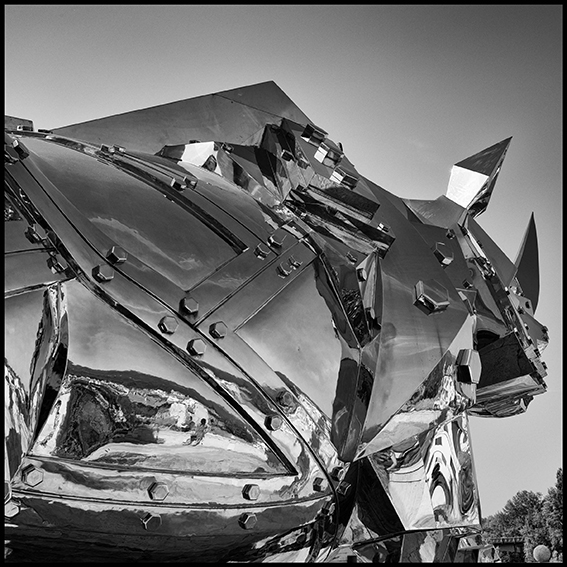
Shih’s use of metal is central to the experience of his sculpture. Bronze carries weight, tactility and historical resonance. Mirrored stainless steel, by contrast, reflects the surrounding world: sky, city, architecture, viewers and movement all enter the surface of the work.
This reflective quality changes the sculpture’s relationship to place. The rhinoceros does not stand apart from the world; it absorbs and reflects it. The viewer becomes part of the image. The city becomes part of the sculpture. Through metal, the work becomes a field of encounter between nature, civilization and the human body.
Why SHIH Li-Jen matters in Taiwanese sculpture
Within Taiwanese contemporary sculpture, SHIH Li-Jen occupies a distinctive position for developing a highly recognizable symbolic language that connects public art, ecological thought and international cultural dialogue. His work does not rely on obvious local imagery, yet it grows from Taiwan’s artistic environment and speaks outward to global concerns.
The rhinoceros allows Shih to address questions that are not limited by geography: extinction, resilience, violence, protection, modernization and the fragile relationship between civilization and nature. This is why his sculpture can stand in Taiwan, Venice or Bassano and still retain its force.
A contemporary totem of civilization
The power of Shih’s rhinoceros lies in its ability to remain accessible without becoming simple. It can be recognized immediately as a strong visual form, yet it continues to open into deeper readings: ecological grief, public memory, civilizational critique and the possibility of guardianship.
This is why the rhinoceros has become more than a motif in Shih’s practice. It is a long-term artistic language. Through it, he gives shape to the tension between force and compassion, monumentality and vulnerability, industrial material and living memory.
To ask “Why the rhinoceros?” is therefore to ask how sculpture can respond to the present age. SHIH Li-Jen’s answer is not given as a slogan, but as a body of work: rhinoceroses that stand in cities, reflect the world, and remind viewers that true strength may lie not in domination, but in protection.
FAQ|SHIH Li-Jen and King Kong Rhino
Who is SHIH Li-Jen?
SHIH Li-Jen is a Taiwanese sculptor and public artist known for the King Kong Rhino series. His work transforms the rhinoceros into a contemporary totem of civilization, ecology, resilience and public art.
What is King Kong Rhino?
King Kong Rhino is Shih’s iconic rhinoceros sculpture series, created in metal and often presented at monumental scale. It combines public sculpture, ecological concern and a symbolic language centered on the rhinoceros.
Why does SHIH Li-Jen create rhinoceros sculptures?
Shih sees the rhinoceros as both powerful and vulnerable. Its endangered condition allows him to reflect on human violence, ecological crisis and the possibility of transforming strength into guardianship.
What does the fingerprint horn mean?
The fingerprint horn transforms the rhinoceros horn from a sign of force into a mark of responsibility. It suggests human presence, identity and accountability within the ecological system.
Where has King Kong Rhino been exhibited?
King Kong Rhino has appeared in international and public contexts including Venice, Bassano del Grappa, Taipei and Shanghai, where it has entered public space and urban memory.