ONE QUICK NOTE
When did Old Master Q begin?
In 1962, Alfonso Wong began creating Old Master Q in Hong Kong, using the name of his eldest son, Wong Chak, as his pen name.
 Modern Art Gallery
More than sixty years on, the cap and long gown are still unmistakable.Old Master Q still shows off, still slips up—and human nature, after all these years, hasn't changed that much.
That familiar silhouette travelled from the creases of newspaper pages into Modern Art Gallery. Alfonso Wong turned vanity, quick thinking and everyday mishaps into compact comic episodes; in Joseph Wong Chak’s hands, the characters moved onto larger canvases, where colour, space and rhythm opened up around them. Cities changed. The gestures remained familiar. Showing off, getting caught out, refusing to back down, quietly finding a way to save face—none of it feels especially dated.
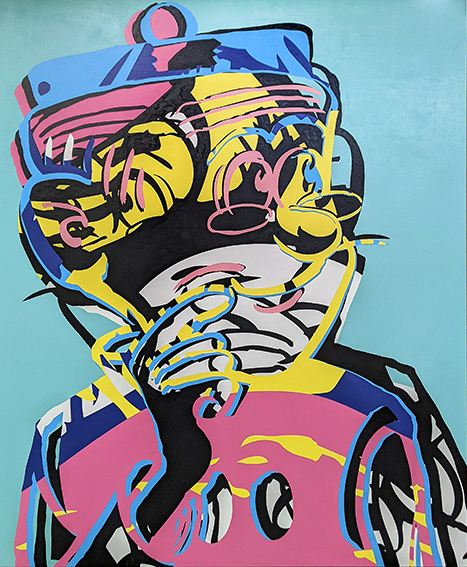
Cities grow taller. People still trip over the same banana peels. New decade, same human comedy.
Old Master Q, Big Potato and Mr Chin—the old gang are far too busy surviving everyday nonsense to lecture anyone.
Try to look cool and take a fall. Get clever and end up cleaning your own mess. Refuse to admit defeat, then quietly search for a way to save face. It worked sixty years ago; it still feels familiar now. Streets change and signs are replaced, but vanity, jealousy, bravado and good intentions gone wrong keep turning up every day.
Seen up close in the gallery, the originals are wonderfully candid: changes in ink, erasures and corrections all remain on the paper. With Joseph Wong Chak, the image opens out. Architectural space, musical timing and Old Master Q’s signature gestures all move onto canvas. Reading one panel at a time becomes something else when you step back and take in the whole painting.
In 1962, Alfonso Wong began creating Old Master Q in Hong Kong, using the name of his eldest son, Wong Chak, as his pen name.
The first “Wong Chak” was Alfonso Wong’s pen name. The second was Wong Chak himself—Joseph Wong Chak—who began continuing the series in 1995.
Showing off and failing, jealousy, stubbornness, friends teasing friends, good intentions going sideways—the situations have barely aged. Add a sharp turn and a dry punchline, and the period flavour becomes part of the charm.
Print looks clean. Originals are less polite. Changes in ink, corrections, overdrawn lines and the marks of the paper remain visible. Each sheet records one particular act of drawing—there isn't another exactly like it.
First the father borrowed his son’s name as a pen name. Decades later, the son inherited the drawing table. Alfonso Wong made “Wong Chak” synonymous with Old Master Q; Joseph Wong Chak kept the name and opened the image in entirely new directions. For a comic built on timing, the handover has a timing of its own.
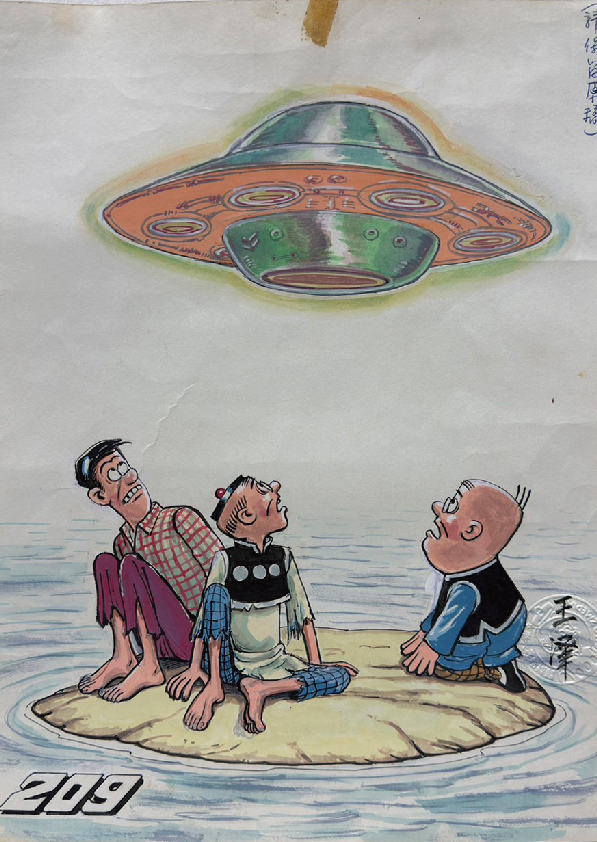
Original drawings reveal what print smooths away: a line pressed harder here, a correction there, a passage redrawn and tried again. You can see how Wong catches an expression, or lands the exact angle of a stumble. The printed page is the finished joke; the original keeps the moment of making it.
Explore original drawings →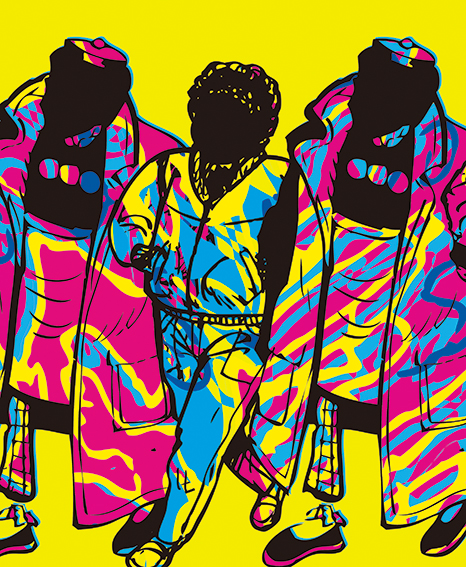
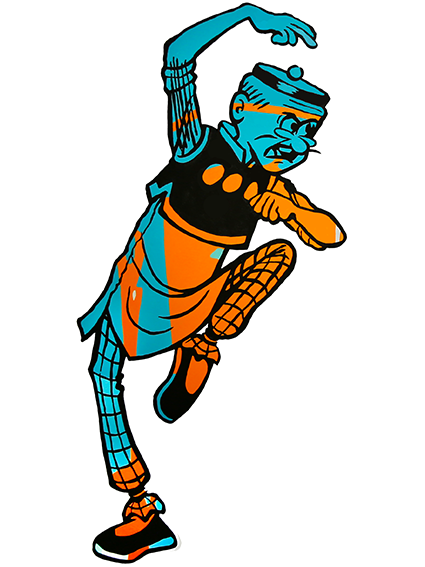
Once Joseph Wong Chak removes the comic panels, Old Master Q is impossible to contain. Arms fold, legs kick, bodies pivot; suddenly the character has room to move. Wong’s architectural sense of space and his feel for musical rhythm enter the canvas as well. Plot can wait. A handful of signature gestures are enough to bring the old personality back.
Explore Joseph Wong Chak →The name came full circle. The drawing continued, and Old Master Q was nowhere near ready to leave the stage.
Four- and six-panel comics rely on buildup and payoff. On canvas, Joseph Wong Chak strips away the before and after. What remains is gesture, silhouette, colour and rhythm—the character reads instantly, without waiting for a final panel.
Swagger, misunderstandings, bad luck—a few panels are enough. Then comes the turn, quick and clean.
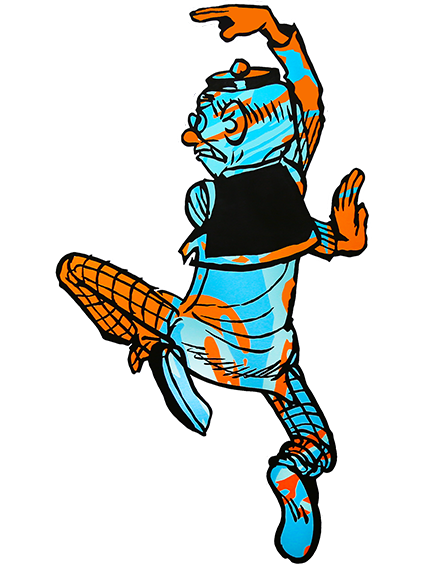
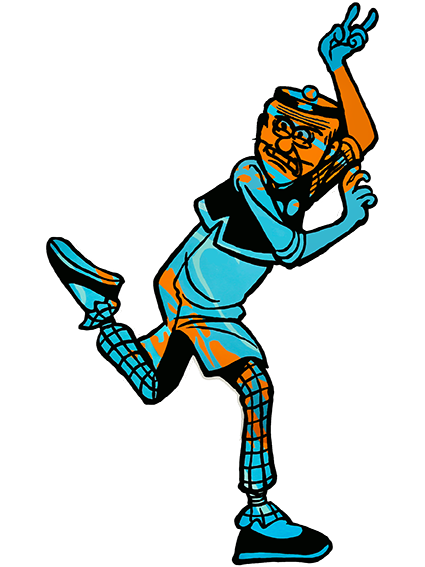
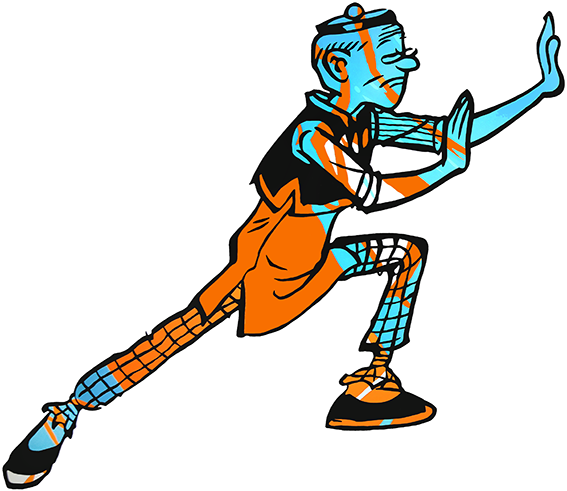
In the Kung Fu Action series, the work itself steps out of the rectangle. A folded arm, a kick, a bend, a turn—the silhouette of the artwork follows the pose. Canvas is combined with wood cut to the figure’s outline, so the object is no longer a conventional rectangular painting; its physical edge becomes part of the movement. With no before or after, one gesture is enough.

Silhouette meets colour, space and beat. No final panel required—stay with it for a moment and the fun shifts into the composition itself.
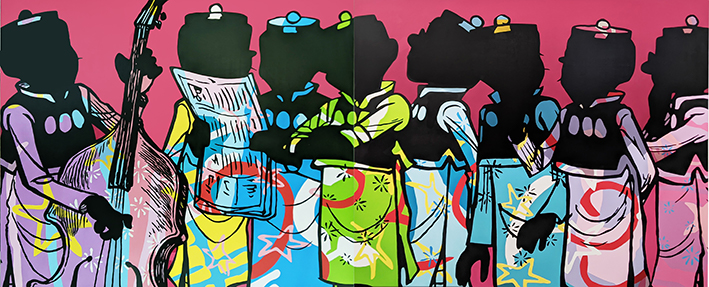
Different faces, different poses—slide sideways for works that haven't appeared above.
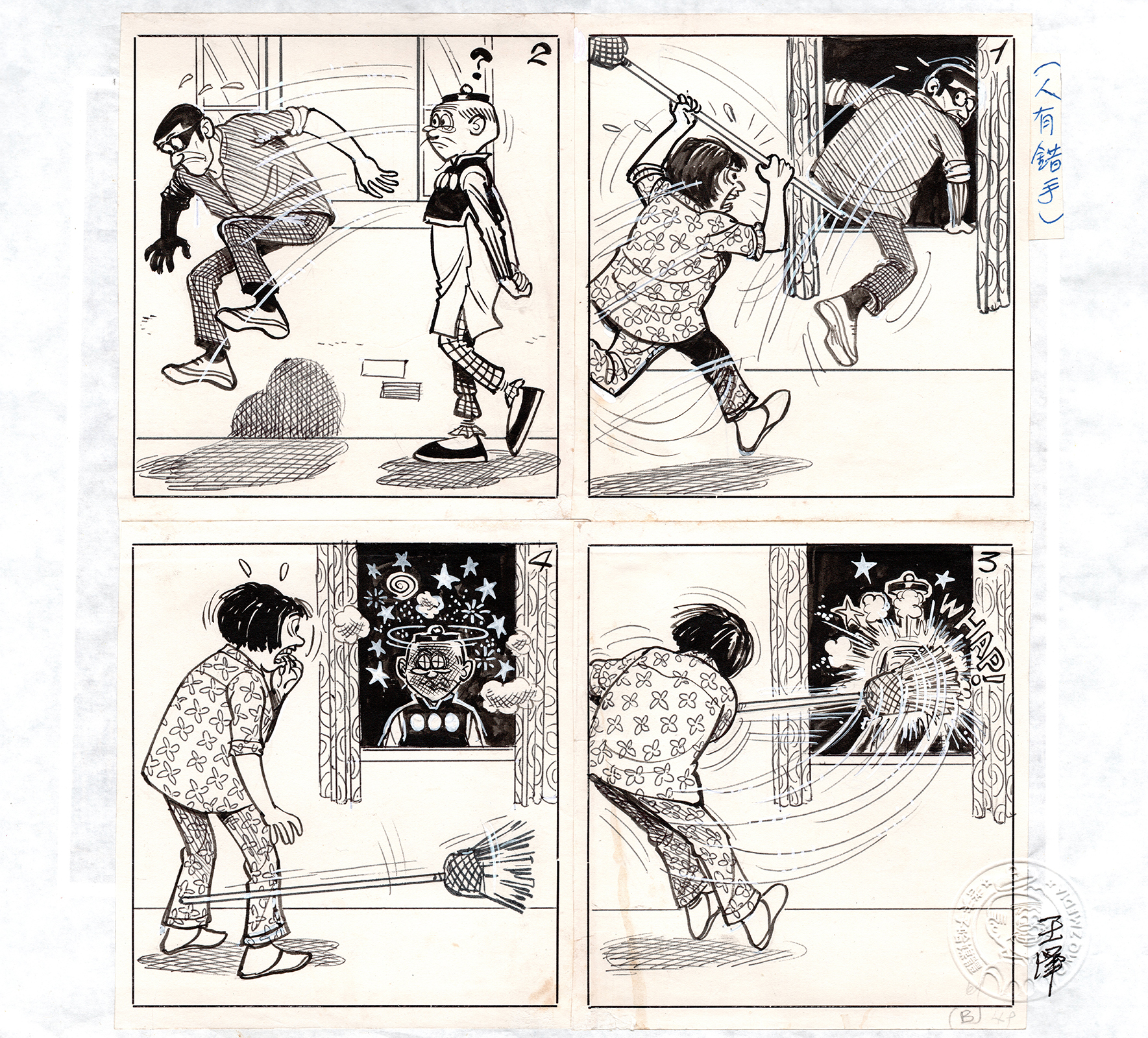
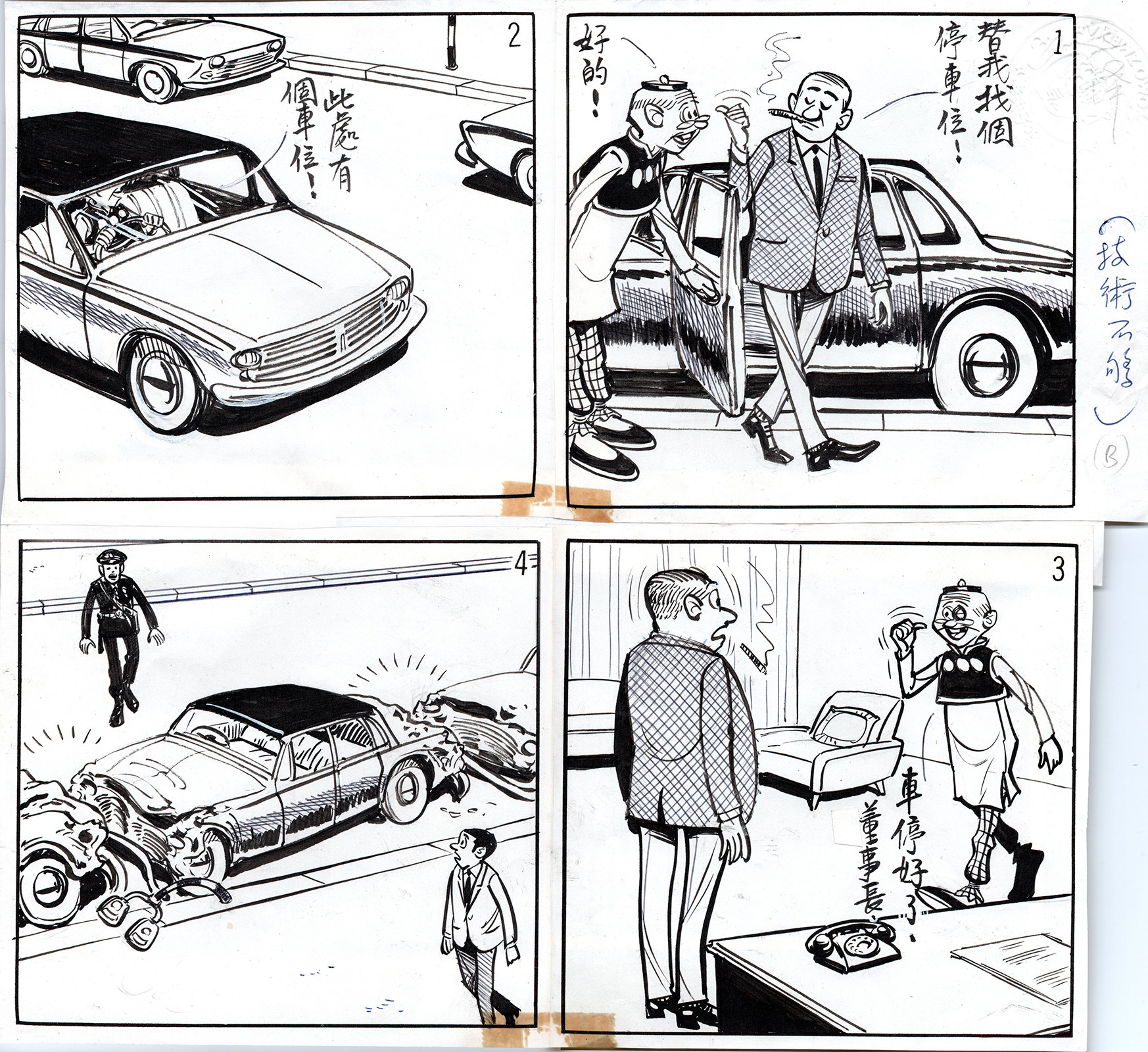


At Sotheby’s and Christie’s, Old Master Q is looked at differently: paper, date, signature and condition come under scrutiny. The familiar characters leave the printed page, and the original work itself takes centre stage.
Funny on the page, yes. At auction, the originals are read through another set of details.
In 2012, Alfonso Wong’s colour originals entered Christie’s Hong Kong’s Asian 20th Century Art sale. In 2014, Sotheby’s Hong Kong followed with a 123-lot dedicated sale, “Old Master Q: What The @#$% Is Going On?”. Paper, ink, signatures and dates—details once hidden behind the printed page—were suddenly laid out for close inspection.
In 2018, Old Master Q 2.0 placed the two generations side by side: early colour covers and four- and six-panel originals alongside Joseph Wong Chak’s acrylic paintings. Christie’s continued to offer works by Alfonso Wong in later sales; in 2025, Sotheby’s Maison returned Old Master Q to the wider history of Hong Kong manhua. Auction, exhibition, cultural history—the character keeps revealing a different side. Modern Art Gallery’s recent exhibitions follow the same thread, bringing original drawings, paintings and both generations into the same viewing space.
Three colour-on-paper originals from 1974, 1982 and 1983 were included in Christie’s Asian 20th Century Art (Day Sale), placing Old Master Q originals within an international twentieth-century art auction category.
View Christie’s lot record ↗Sotheby’s Hong Kong organised a dedicated sale of 123 original works by Alfonso Wong. Seen together, the group made the breadth of Wong’s characters, drawing, subjects and period sensibility unusually clear.
Early colour covers and four- and six-panel originals were shown alongside Joseph Wong Chak’s Implication paintings. The sale also included Old Master Q – Rock’n Roll (1964), described by Sotheby’s as the earliest surviving cover work then offered.
Alfonso Wong’s colour-on-paper work Rejuvenation returned to Christie’s Hong Kong in an online Chinese paintings sale. Estimated at HK$20,000–40,000, it realised HK$150,000.
In Exploring Hong Kong Manhua: A Century of Comics and Visual Culture, Sotheby’s placed Old Master Q within a century of Hong Kong comics and visual culture, with related works presented in Our Bygone Days.
Read Sotheby’s Hong Kong manhua article ↗From 2020 to 2025, Old Master Q kept changing rooms—and changing shape. Each stop left something different behind.
From Modern Art Gallery’s exhibition walls in Taichung to the international booths of Art Taipei, Old Master Q has moved through a surprising range of settings. Manuscript exhibitions brought viewers close to paper and ink; group shows placed two generations and different media in conversation; at art fairs, familiar figures took on a different scale and presence. Across 2020–2025, comic memory, original drawings and contemporary painting gradually formed one continuous thread. The archive is still open. What comes next is anyone’s guess.
From first-generation originals and second-generation paintings to Modern Art Gallery’s exhibition archive and selected works—pick the thread that interests you and keep going.
Return to the original comic language, ink lines and drawings of the first generation.
Follow the character from comic originals into acrylic painting and contemporary art.
Browse series, individual works, dimensions and shaped canvas-and-wood pieces.
Continue through Modern Art Gallery’s exhibition history and related projects.
Old Master Q 老夫子 — More than sixty years on, an old friend is still here: ink on paper, colour on canvas, each carrying the character in a different way.
See the works again →