No Trade, No Harm
| 裝置 Installation 犀角:92 × 40 × 80 cm 外圈尺寸依展覽現場而變化 |
「沒有買賣,就沒有殺害」——這不僅是保育口號,更是殘酷的資本邏輯。
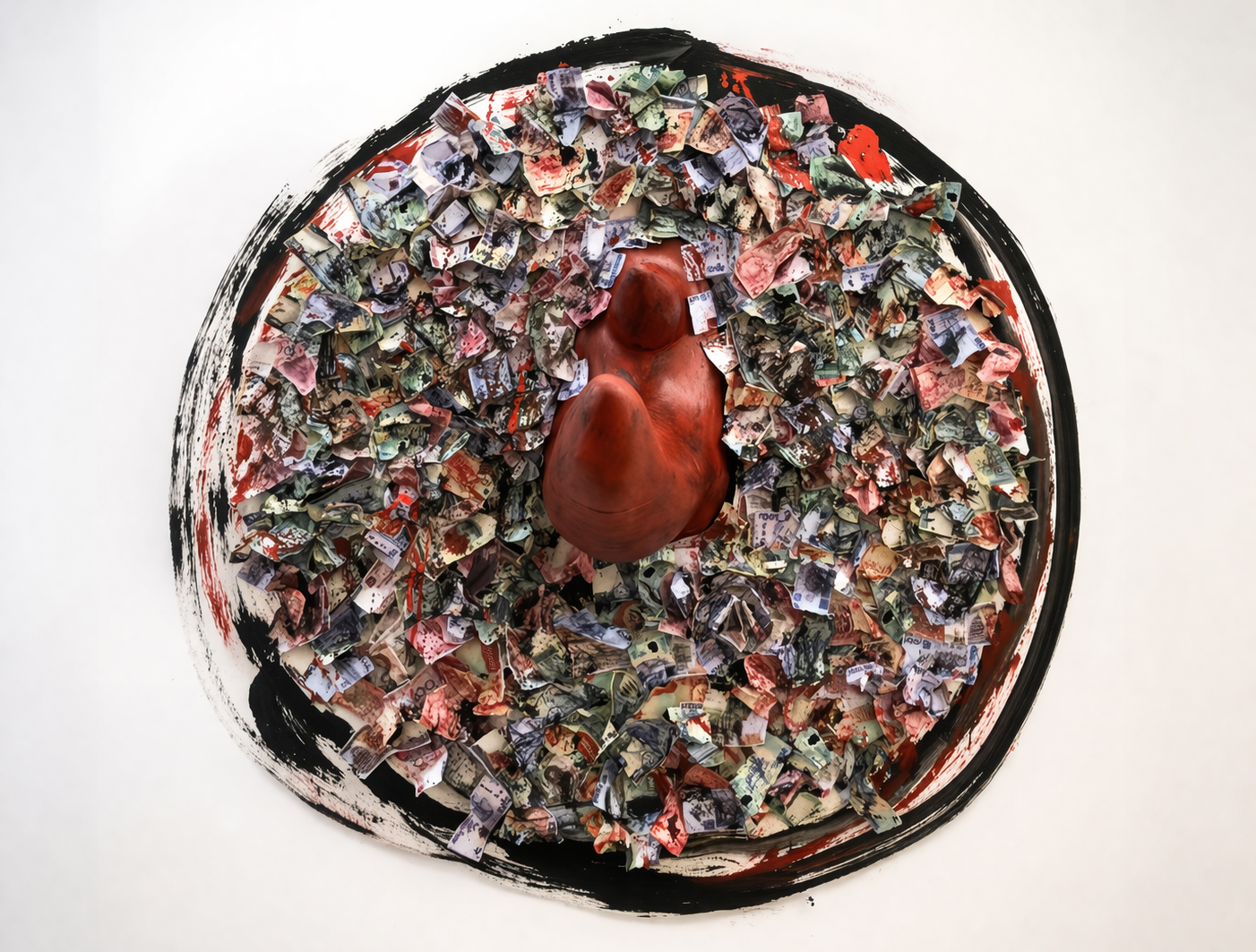
在《珍犀生命》中,施力仁將鮮紅如血的犀角懸置於撕裂、混雜的多國紙鈔之上。多國因犀牛角黑市交易鏈上的貨幣,在此構建出一個全球欲望的縮影。金錢不再只是中性的交換媒介,而是推動殺戮的具體證物。
施力仁以此作揭示了當代文明的荒謬:原本作為生存尊嚴的犀角,在市場機制下被解構為價格與商品。透過對左鎮化石與華夏圖騰的追溯,他引導觀者思考——當世界習慣以價格衡量一切,我們是否正親手將生命推向可被犧牲的祭壇?
施力仁長年以犀牛為創作主題,並非僅出於動物造型的興趣,而是對生命受害狀態的深刻感受。犀牛本為古老、沉靜而強韌的物種,卻因犀角被賦予不合理的藥用、收藏與炫富價值,反而成為最容易被暴力索取的對象。《珍犀生命》將這種荒謬推向極致:原本作為生存器官的角,在人類欲望之中被轉換為價格、商品與血腥利益,並由此揭示當代文明如何透過市場機制將生命物化。
這件作品同時也與施力仁一貫的文化思考相關。在亞洲文化中,犀牛並非陌生形象,從古代器物、文獻與圖騰中皆可見其存在;而在台灣,左鎮地區曾出土犀牛化石,也提示犀牛曾經屬於這片土地的遠古生命史。也因此,在施力仁的作品裡,犀牛既是國際保育議題的對象,也是文化記憶、土地歷史與生命倫理的交會點。
2017年威尼斯雙年展《金剛犀牛》引起國際廣泛關注後,施力仁於翌年受邀參加薩爾斯堡邦文化機構主辦的展覽《Schilling, Mark, Dollar, Euro und … Geld in der Kunst》。展覽以「金錢」為核心,匯集不同國家與世代藝術家的作品,探討金錢在物質、象徵與社會結構中的多重意義。《珍犀生命》置身其中,格外鮮明地指出:真正值得追問的,不只是金錢如何被表現,而是金錢如何滲入生命價值的判斷,甚至成為殺害他者的推動力量。
「沒有買賣,就沒有殺害」在這件作品中不是口號,而是一個殘酷的現實邏輯。施力仁透過《珍犀生命》所提出的,並不只是對犀牛命運的悲憫,更是對整體人類文明的反思:當世界已習慣以價格衡量一切,生命是否也正在被推向可交換、可消耗、可犧牲的位置?作品由此引導觀者重新面對生與死、人與自然、東方與西方、文明與暴力之間的深層關係。
No Trade, No Harm is a major installation created by SHIH Li-Jen for his 2018 exhibition at Kunst im Traklhaus in Salzburg, Austria, and was included in the exhibition publication Schilling, Mark, Dollar, Euro: Geld in der Kunst. This context is crucial to understanding the work: rather than functioning solely as an appeal for wildlife protection, the installation enters a broader international discourse on money, value, exchange, and the moral failures embedded in economic systems.
At the center of the work hangs a rhinoceros horn rendered in a vivid blood-red form, suspended against a circular field densely composed of fragmented banknotes from multiple countries. The accumulation, tearing, and compression of currency create an image of global circulation and illicit exchange. In this setting, money is no longer neutral. It becomes evidence—an active force within a system of extraction, black-market trafficking, and violence. The horn, which for the rhinoceros is a means of survival, is transformed by human desire into a priced object, a luxury fetish, and a source of death.
SHIH Li-Jen has long approached the rhinoceros not merely as an animal form, but as a vehicle through which questions of culture, ethics, history, and civilization can be confronted. In No Trade, No Harm, that symbolic language reaches a particularly direct and painful clarity. The work lays bare the mechanism through which life is converted into value and value into profit. It exposes how the market, when detached from ethical consciousness, can normalize destruction and conceal brutality behind the logic of demand.
The work also resonates with deeper cultural and historical layers. In Asian visual and material culture, the rhinoceros appears in ancient ritual vessels, texts, and symbolic traditions. In Taiwan, rhinoceros fossils discovered in Zuozhen further connect the animal to the island’s prehistoric ecology. As such, the rhinoceros in SHIH’s work is not only a global emblem of endangered life, but also a figure tied to memory, land, and the long arc of civilizational consciousness.
Following the international attention generated by King Kong Rhino at the 2017 Venice Biennale, SHIH was invited in 2018 to participate in the Salzburg exhibition Schilling, Mark, Dollar, Euro und … Geld in der Kunst, a project bringing together artists from different countries and generations to examine money as cultural material and artistic subject. Within this curatorial framework, No Trade, No Harm stands out for the urgency with which it redefines the meaning of value. The central question is no longer what money represents, but what money permits, distorts, and destroys.
In this sense, “No trade, no harm” is not presented as a slogan, but as an ethical proposition. The work asks the viewer to confront a difficult truth: when all things are drawn into systems of exchange, life itself risks being reduced to something tradable, expendable, and sacrificial. What is endangered, then, is not only the rhinoceros, but humanity’s own capacity to remain in a just and responsible relationship with the natural world.
出版資訊 Publication
本展覽出版正式圖錄:
Schilling, Mark, Dollar, Euro: Geld in der Kunst
Author / Editor: Dietgard Grimmer
Format: Paperback
Publication Date: 30 July 2018
此出版物以「金錢作為文化物質與藝術主題」為核心,收錄來自不同國家與世代藝術家的作品,涵蓋以紙幣、硬幣、支票、攝影、錄像、繪畫與物件等多元形式展開的創作。施力仁《No Trade, No Harm 珍犀生命》所處的展覽脈絡,正是在此關於金錢、價值與社會關係的討論之中,被清楚定位為一件關注非法交易、生態暴力與生命倫理的裝置作品。
展覽資訊 Exhibition Information
展覽名稱:希林,馬克,美元,歐元和……藝術中的錢
Schilling, Mark, Dollar, Euro und … Geld in der Kunst
展覽日期:2018.07.25 – 2018.09.15
展覽地點:Kunst im Traklhaus, Salzburg, Austria
主辦單位:Kunst im Traklhaus
策展/館方主持:Dr. Dietgard Grimmer
出版品:Schilling, Mark, Dollar, Euro: Geld in der Kunst
官方網站:www.traklhaus.at
Curatorial Context
本展聚焦於「金錢」在當代藝術中的多重面向:作為物質、作為象徵,也作為支配生活與價值判斷的社會機制。施力仁《珍犀生命》置身於此策展框架之中,將金錢與生命直接對置,使「價值」不再只是抽象概念,而成為牽動暴力、慾望與物種存亡的現實問題。作品因此不只是回應保育議題,更將觀者帶入對文明秩序與倫理結構的深層思考。